


























Agents · A voice-first agent maker

Milo: Talk your own agents
into existence.

Milo is a voice-first agent maker built by Suman Debnath. Its owner describes a small job out loud; Milo casts one of 24 fluffy characters to do it, and on a yes the agent runs on its own schedule and reports back, asking first before anything leaves the app. It is a starting app: basic agents today, external connectors next.

No sign-up form, no flowchart, no code. Milo asks your name and what would make your week easier, then turns the answer into a little helper you can see, rename, pause and watch at work.

Voice-first24 characters23 one-tap startersAsks before it actsInstallable web app

Live, for one owner · a starting app, version one · Milo’s own page ↗

Hi, I’m Milo! 👋

psst — poke him

24

fluffy characters in the cast

23

ready-made starters, one tap each

16

voices to choose for Milo

0

sign-up forms — he asks, you answer

0

API keys or AI accounts you bring

$0

a month to run

The short · on YouTube

Build your own AI agents just by talking.

The quickest way to understand Milo is to watch him. You say what you need; Milo turns it into a small agent with a face, a name and a schedule. Three beats carry the whole idea:

  1. 01No forms.Your profile fills in while you talk — name, work, city, interests.
  2. 02It runs on its own.A first run straight away, then on schedule, with a buzz on your phone.
  3. 03It asks before it acts.Anything outward waits on a “Needs your OK” card.
Open it on YouTube ↗

Talking. Mouth on every syllable.

Show Milo

Meet Milo

A fluffy tangerine planet with a moon full of agents.

Big glossy eyes, a little blush, a tiny “w” of a mouth, and fur drawn entirely by SVG filters — no image files. He is the app’s logo too: the mark is Milo himself, and the dot on the i in “milo” is his moon.

  • 1

    The moon is the agents he makes

    It floats while Milo waits and orbits while he thinks.

  • 2

    He talks with his whole body

    His body swells with his voice, his little “w” mouth opens on every syllable, and a ring around him answers yours.

  • 3

    He blinks, and he looks up to think

    Every five and a half seconds, and whenever he’s working something out.

  • 4

    Sixteen voices, and he learns your accent

    Pick his voice and hear each one instantly; set how you speak — Indian English, say — and he listens for your names and places.

His personality, as written in his prompt

  • Warm, curious, a bit playful, never cheesy
  • One or two sentences a turn, one question at a time
  • Never pretends, never reads out tool names
  • Never asks for passwords, bank details, ID numbers, your address, phone or birth date
Tangerine#FF6F3CMoon#FFD6C2Blush#FF8FA3Ink#1A1418

How it works

No forms, no flowcharts. Just a conversation.

Voice first, never voice only — everything also works by typing and tapping. These are the real screens, from the app’s example profile with real agent runs.

  1. 01

    Say what you need

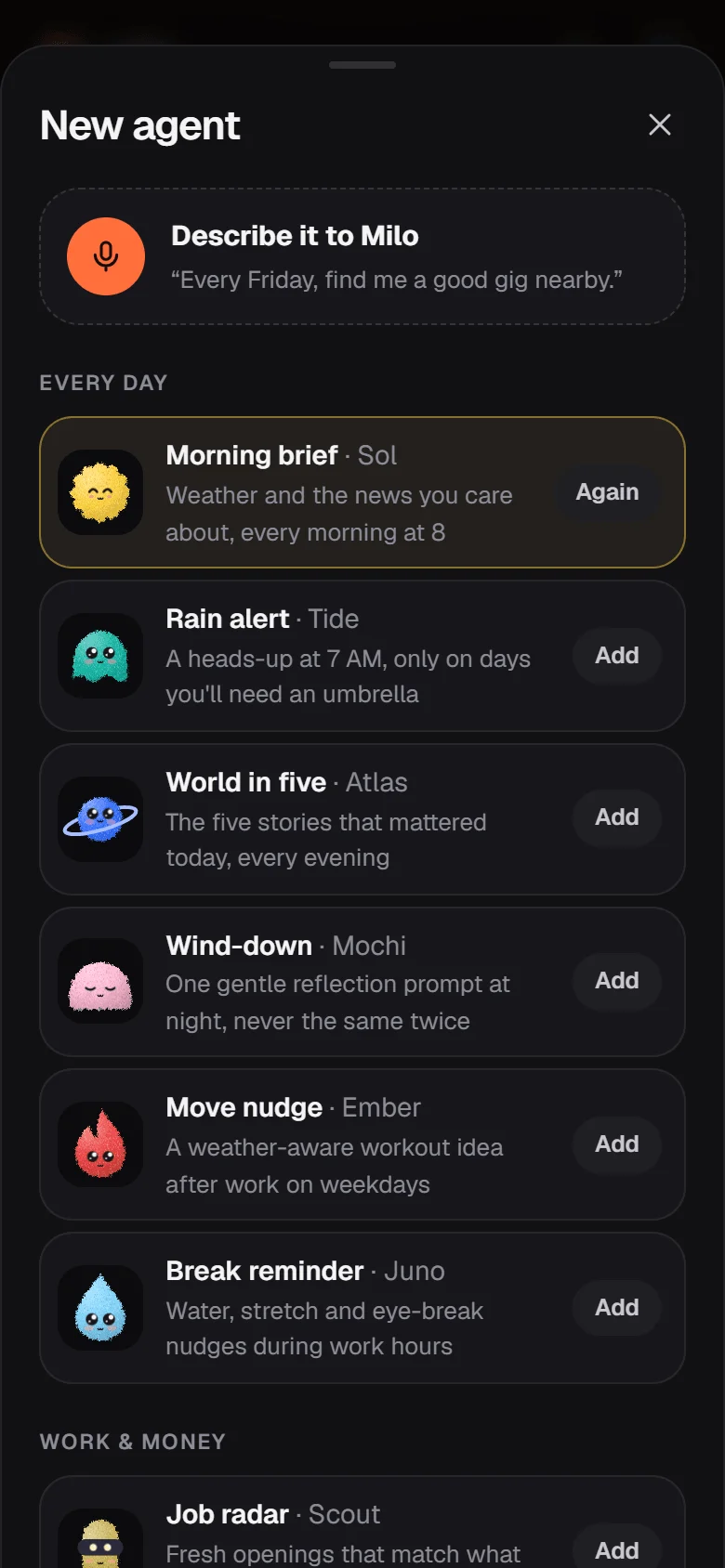
    “Every Friday, find me a good gig nearby.” Milo asks one or two questions, never a form. Not sure where to start? Ask what it can make, and all the starters open on screen.

    The New agent sheet: “Describe it to Milo”, then ready-made starters such as Morning brief, Rain alert and World in five
  2. 02

    Meet your agent

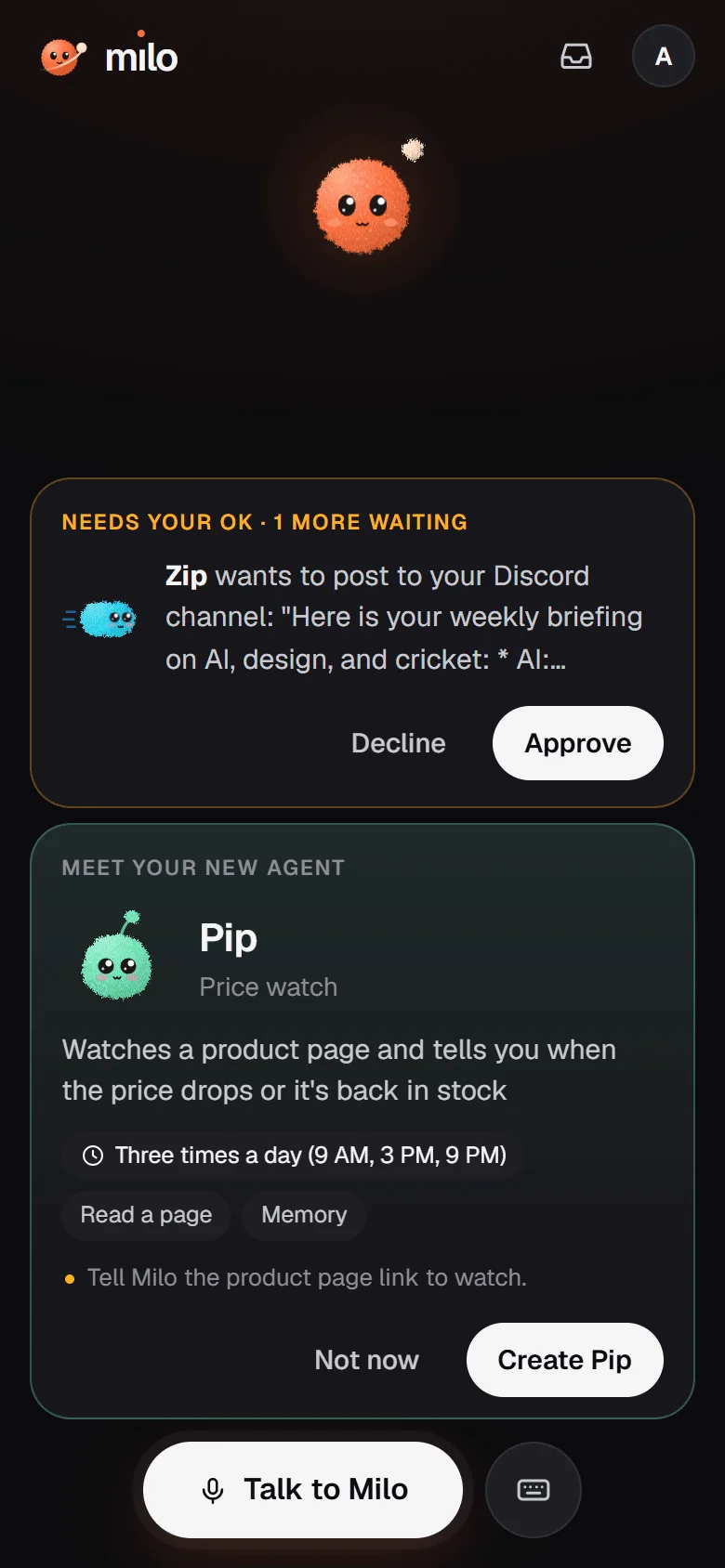
    A character steps forward with what it will do, when, and with which tools. Say yes, or tap Create, and it exists. Ask for changes — “make it 9 instead”, “call it Penny” — and the card updates.

    A “Meet your new agent” card for Pip, a price watcher, with its schedule, its tools and a Create Pip button
  3. 03

    It gets to work

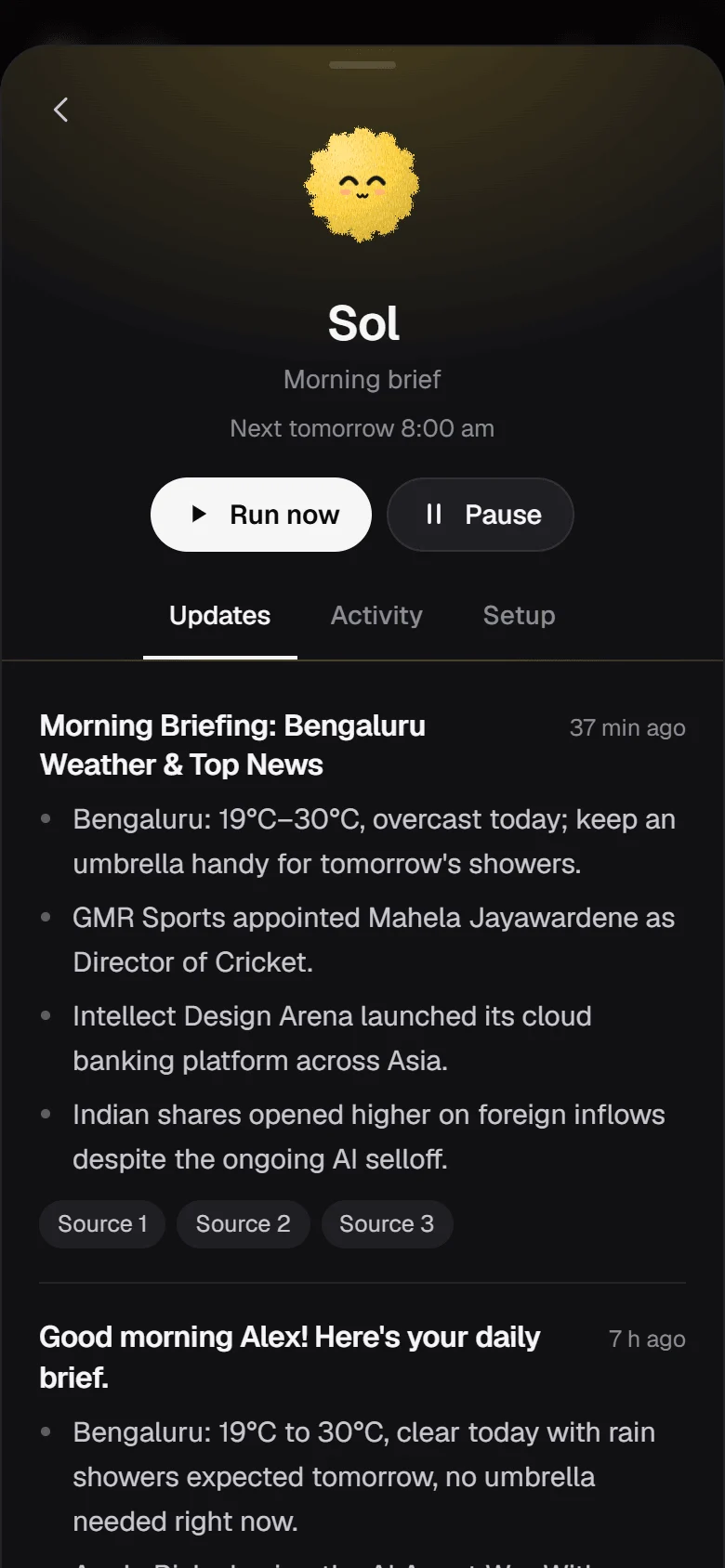
    It does a first run straight away, then keeps its own schedule in your time zone. Every agent has its own page: its updates, every step of every run, and the instructions Milo wrote for it.

    Sol’s own page with Run now and Pause, and its morning brief under Updates
  4. 04

    It asks before it acts

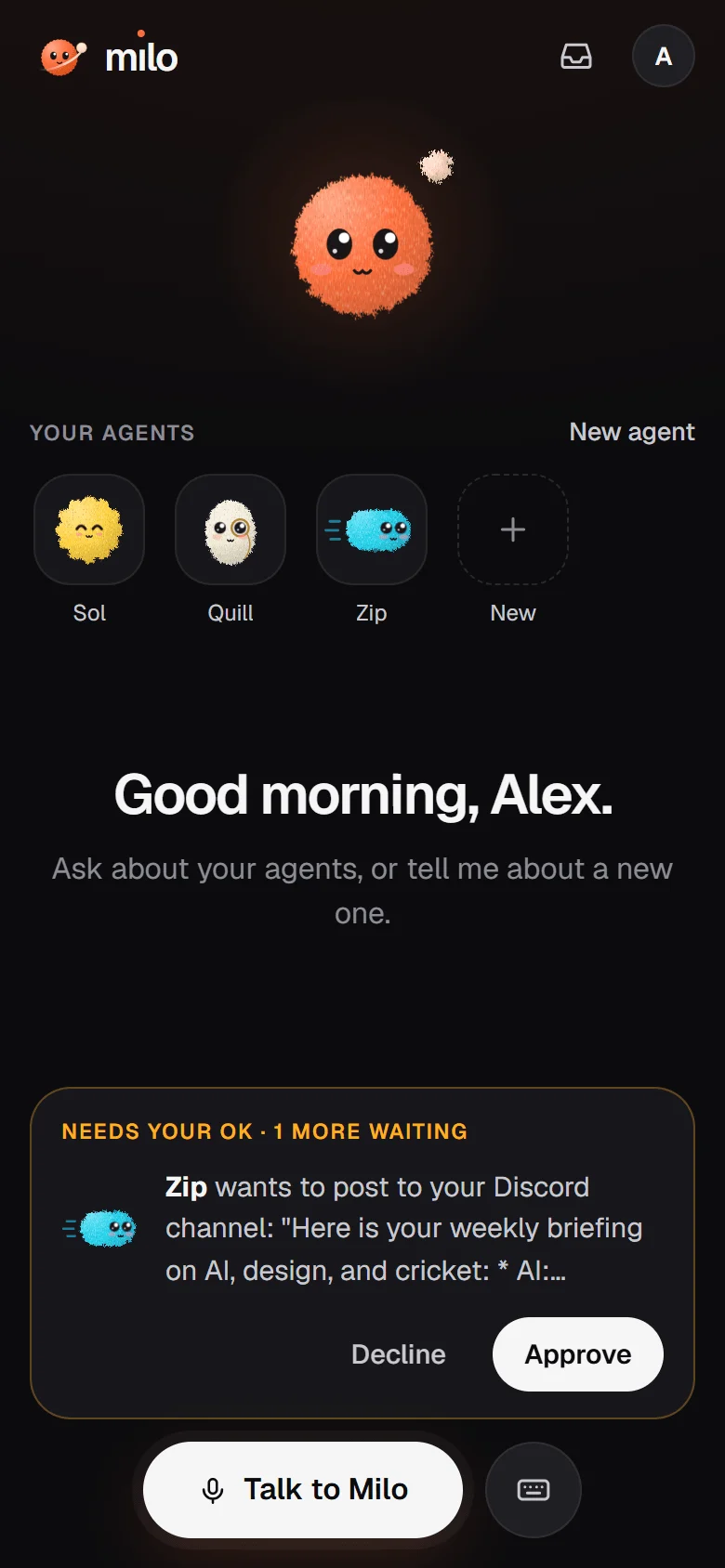
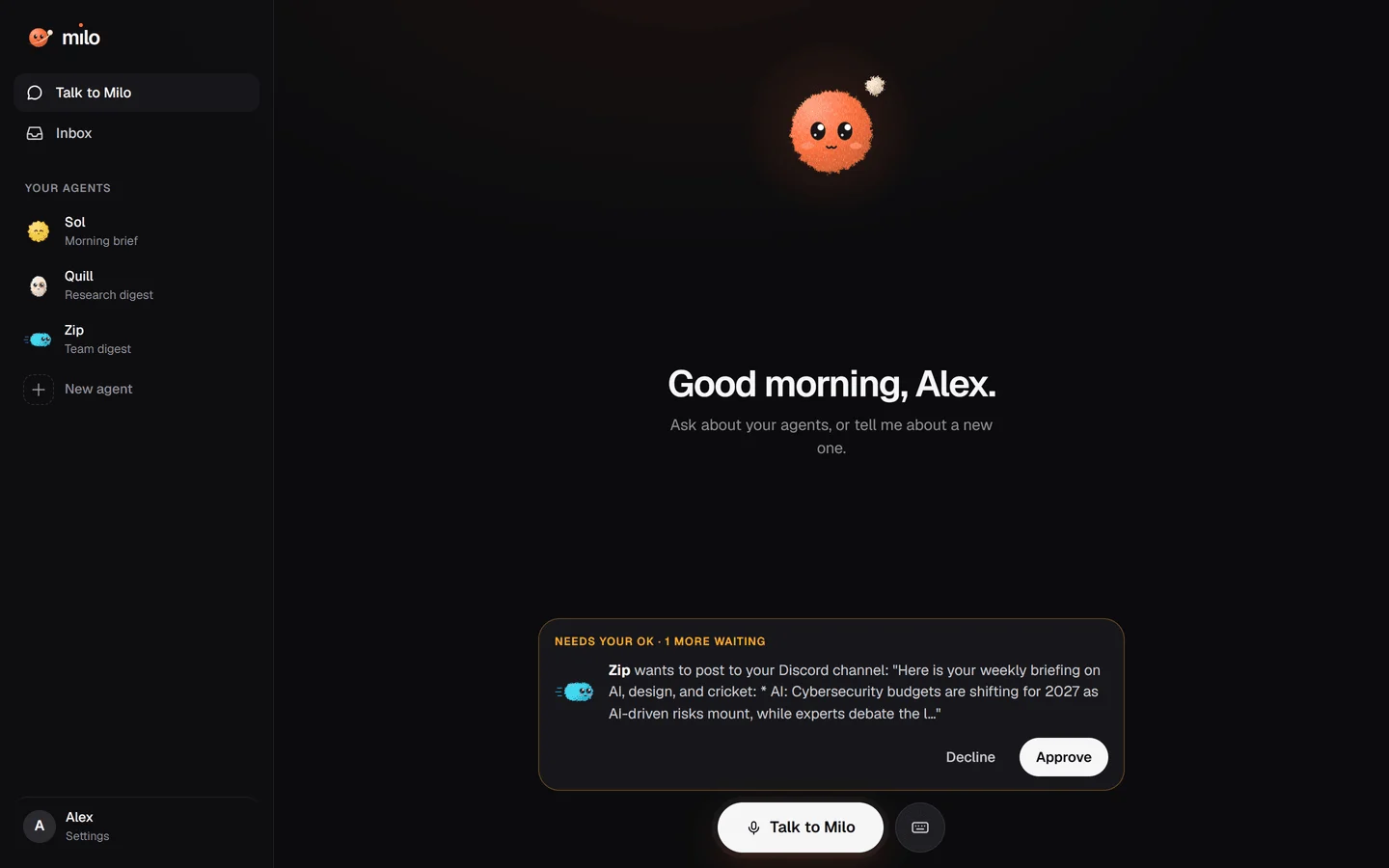
    Anything that reaches the outside world — today, a post to Discord or Slack — waits on a “Needs your OK” card, a phone notification or a spoken yes. What you approve is exactly what runs.

    Milo’s home screen: Milo floating at the top, the agents Sol, Quill and Zip, and a “Needs your OK” card where Zip asks to post to Discord
The inbox, filtered by agent, with a research update from Quill and a morning briefing from Sol

The inbox — every message, filterable by agent

milo · on a wide screen
Milo on a wide screen, with the agents in a sidebar and an approval card waiting above the Talk to Milo button

On a laptop the crew moves into a sidebar. Installable on Android, iPhone and desktop.

Try it · a toy version

Go on, make one.

Tap a wish or type your own, and watch Milo decide who plays it. The wishes are real starters. For anything you type, this toy runs the app’s fallback rule — match your words against each character’s keywords, prefer someone not already on your crew — and shows you what it matched.

Tell me what would make your week easier.

Tap a wish

The new agent’s card shows up here, the way it does in the app.

Your agents

A toy built from Milo’s real cast, starters and fallback character-picking rule — nothing you type leaves this page. In the app this happens by voice, Milo asks a question or two and writes the full spec, and the agent then really runs.

The cast · 24 characters

Every agent is someone.

Twenty-four fluffy little characters, each with a name, a colour and a way of talking. Milo picks the one whose strengths fit the job, and its persona is added to the agent’s instructions every time it runs — so Sol sounds bright and brief, and Rook calm and protective. Tap a card to flip it.

Never human, never realistic, never scary, and no text on them. Rename an agent and the character stays. Milo isn’t in the cast — he’s the one who makes them.

What Milo can make today

Twenty-three helpers, one tap each.

Ready-made agents in Milo’s five groups, each filled in from your profile and played by its own character. They need no AI to draft, so they still work when the model is busy. Ask Milo “what can you make?” and the whole list opens on screen.

  • SolMorning brief · SolWeather and the news you care about, every morning at 8Every day at 8:00 AMWeatherNewsNeeds: Your city; your interests come from your profile
  • TideRain alert · TideA heads-up at 7 AM, only on days you’ll need an umbrellaEvery day at 7:00 AM, only if neededWeatherNeeds: Your city
  • AtlasWorld in five · AtlasThe five stories that mattered today, every eveningEvery day at 7:00 PMNewsNeeds: Nothing — tell it your topics if you like
  • MochiWind-down · MochiOne gentle reflection prompt at night, never the same twiceEvery night at 10:30 PMMemoryNeeds: Nothing
  • EmberMove nudge · EmberA weather-aware workout idea after work on weekdaysWeekdays at 6:30 PMWeatherMemoryNeeds: Your city
  • JunoBreak reminder · JunoWater, stretch and eye-break nudges during work hoursWeekdays at 11, 1, 3 and 5MemoryNeeds: Your working hours, if they differ

Or just describe one.

These work today with the tools Milo already has — the character is picked for you.

  • Visa appointment watcher· Pip
  • Exam result watcher· Bolt
  • Society notice-board watcher· Pip
  • Rental listings scout· Scout
  • Competitor pricing watch· Pip
  • Grant, hackathon & CFP finder· Scout
  • Next-morning cricket match wrap· Atlas
  • Local events this week· Tango
  • New books from authors you love· Echo
  • Phone launch tracker· Bram
  • Monday goals nudge· Loom
  • Festival & holiday planner· Kiwi

Honest status

A starting app. Small agents first.

Milo is version one, and it says so. Today it makes basic, single-job agents that read the public web, remember what they already told you, and report back. Full-scale agents that work inside your other accounts and services — email, calendar, code — are the plan for what comes next, not something it does yet.

● Today

Basic agents, done well

  • Check the weather and the news
  • Search the web and read a public page
  • Remember what it already told you
  • Message you — in Milo, as a phone notification with its own face, or on Telegram
  • Post to a Discord or Slack channel, after your OK

Its honest limits

  • Public pages only — no logins, so no bank, email or social accounts
  • Runs at most every 15 minutes
  • Prices read from page text can miss ones a site loads with scripts
  • One owner, up to 20 agents
On the roadmap

◌ Next

Full-scale external agents

  • Inbox triage, bills and parcelsReading email, read-only
  • Calendar briefings and meeting prepReading your calendar
  • GitHub watchers and workflow triggersTriggers ask first
  • RSS, live market prices, air qualityNew free data sources
  • Agent-to-agent hand-offsOne agent’s result starts another
  • MCP connectors for toolsPlug in outside tools
  • Chat with an agent directlyAsk Sol, not just Milo
  • Android build and more than one ownerAccounts, one hub each

Same rules as today: free services only, and anything that acts outward asks first. Still never: buying, booking or paying on your behalf.

Under the hood

Agents are data, not code.

Behind the fur is one React web app and one Cloudflare Worker. Four decisions do most of the work.

01

An agent is a spec, not a script

Describe a job and a model writes a JSON spec — name, character, schedule, tools, instructions. Before you ever see the card it is validated and repaired against a fixed tool catalogue: an unknown tool is dropped, a too-frequent schedule is slowed to every fifteen minutes, a character already in use is swapped for a free one. Models write specs; they never write or run code.

A bad draft never becomes a broken agent.

02

Every agent gets its own home

Each agent is its own Cloudflare Durable Object, with its own SQLite storage, memory, run history and alarm clock. The alarm is the schedule, computed in your time zone, so an agent runs whether the phone is open or not — and two runs of the same agent can never overlap.

Its schedule is an alarm it carries, not a cron job somewhere else.
03

What you approve is exactly what runs

A tool that acts on the outside world is forced to ask. The request is stored with the exact tool and arguments, and on your yes that stored call runs directly, with no model in between, so nothing can be reworded after you said yes.

No AI between your yes and the action.
04

Built to survive a live demo

Every dependency has a fallback. Natural voice falls back to the browser’s own voice, then to typing. Each model falls back to the next, then to a backup provider. Drafting falls back to the starters, which need no model at all. Phone notifications are Web Push written from scratch and checked byte for byte against the RFC 8291 test vectors.

When the model is down, the starters still work.

8

model steps per run

12

tool calls per run

15 min

shortest schedule

20

agents per owner

50

memory notes per agent

15

runs kept per agent

React 19 PWAViteCloudflare WorkersDurable Objects · SQLiteSpeech-to-speech voice with tool callsWeb Push · RFC 8291 · no librariesTelegramDiscord & Slack webhooksVercel front door

What would you like help with?

The app itself is personal — one owner, behind a passcode. Milo’s public page and the short show him at work.

Made with love (and a lot of fur) 🧡

Questions this page answers

What is Milo, the voice-first agent maker?
Milo is a voice-first web app by Suman Debnath that turns a spoken request into a small AI agent. Milo asks a question or two, casts one of 24 fluffy characters to play the agent, and on a yes the agent runs straight away and then on its own schedule, messaging its owner in the app, by phone notification or on Telegram. Anything that would act on the outside world waits for approval.
What kinds of agents can Milo build today?
Milo builds basic, single-job agents: a morning weather-and-news brief, a rain alert, a price watcher, a job radar, a research digest, a word of the day, an uptime check — 23 ready-made starters in all, or one described in plain words. Its agents check weather and news, search the web, read public pages, remember past runs and post to Discord or Slack after approval. They cannot log in to sites, read email or calendars, or buy anything yet; those connectors are on the roadmap.
How does Milo stop an AI agent from doing something unexpected?
Milo treats each agent as data rather than code: a model writes a JSON spec, which is validated and repaired against a fixed tool catalogue, and each run may use only the tools that agent declared, up to 8 model steps and 12 tool calls. Any outward action, such as posting to a team channel, becomes an approval request, and after approval the stored action runs exactly as approved with no model in between.

Let's Build
What Comes Next.

Suman Debnath Signature

Open to meaningful collaborations, AI-native systems, product strategy, and future-focused conversations.

“Human instinct. AI amplification.
Systemic execution.”

Suman Debnath

·

Brand Marketing Leader & AI Product Builder

© 2026

This site records visit data — pages viewed, time and scroll depth, device, your IP address and the approximate location and network provider derived from it — and sends it to me privately. It also runs Google Analytics and Vercel Analytics. Full detail and how to opt out.

This site, its code and its content are © 2026 Suman Debnath. All rights reserved — none of it is open source, and copying it needs permission first. Terms of use.

Play my career